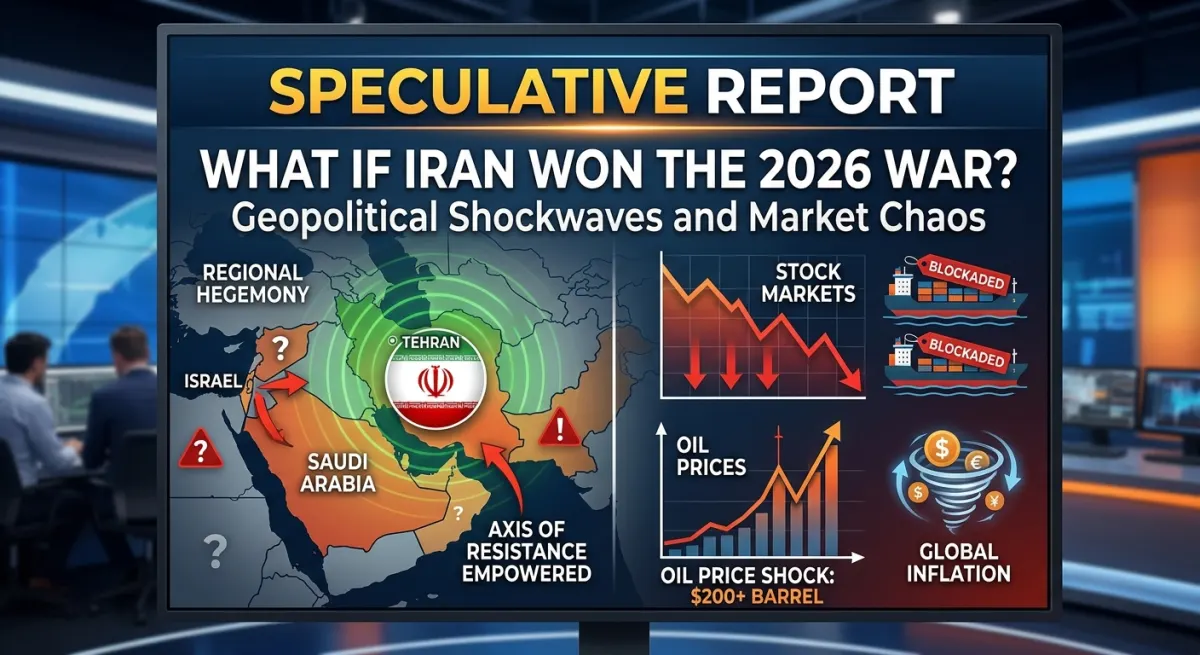
One month into Operation Epic Fury, the conflict between the U.S., Israel, and Iran has already reshaped global markets and regional stability. But what if the trajectory shifted dramatically-what if Iran, against conventional military odds, managed to force a U.S. withdrawal and claim victory? The scenario seems unlikely given American air superiority, yet geopolitical surprises have upended markets before, and the implications would be staggering.
An Iranian victory wouldn't require defeating the U.S. military outright. It could mean exhausting American political will, sustaining enough damage to Israeli and Gulf allies to force negotiations, or simply outlasting Trump's appetite for continued engagement. The consequences would ripple across energy markets, geopolitics, and investor confidence in ways that would dwarf current volatility.
What Could Happen: The Immediate Aftermath
If Iran emerged victorious-or even if the U.S. simply withdrew without achieving its stated objectives-the regional balance of power would invert. Iran's nuclear program would remain intact, its missile and drone capabilities would be demonstrated as resilient, and its influence across the Middle East would expand dramatically.
Military and Political Consequences
- Iran would consolidate control over proxy networks in Iraq, Syria, Lebanon, and Yemen, effectively creating a land corridor from Tehran to the Mediterranean
- Saudi Arabia and the UAE would face unprecedented pressure, potentially accelerating their pivot toward China and away from U.S. security guarantees
- Israel would confront a newly emboldened adversary with demonstrated air defense capabilities and a narrative of having survived American firepower
- The credibility of U.S. security commitments to regional allies would crater, forcing a fundamental reassessment of Middle East alliances
- Nuclear proliferation would likely accelerate as Saudi Arabia, Turkey, and potentially others pursue weapons programs to counter Iranian dominance
- Hezbollah, the Houthis, and other Iranian-aligned groups would gain legitimacy and resources, destabilizing Lebanon, Yemen, and the Red Sea
Domestic U.S. Political Fallout
Domestically, an Iranian victory would represent a significant political defeat for President Trump, regardless of his rhetoric about "winning enough." The narrative of American decline would dominate headlines, potentially triggering a broader reassessment of U.S. military capabilities and resolve. Congress would face intense pressure to authorize additional military action or, conversely, to demand a complete withdrawal from Middle East entanglements.
Key Context: The U.S. has amassed military assets in the region at levels not seen since the 2003 Iraq invasion. An inability to achieve objectives despite this concentration of force would signal a fundamental shift in American power projection capabilities, with ramifications far beyond the Middle East.
Market Impact: Oil, Shipping, and Global Growth
The economic consequences would be severe and immediate. Oil markets would experience a shock that would make current volatility seem tame by comparison.
Energy Markets Under Stress
- Crude oil could spike to $150-$200 per barrel as investors price in sustained Iranian control of the Strait of Hormuz and potential attacks on Gulf infrastructure
- The Strait of Hormuz, through which roughly 20% of global oil passes, would remain a contested zone with Iranian leverage over shipping and pricing
- LNG prices would surge as European and Asian buyers scramble for alternative energy sources, straining global liquefied natural gas markets
- Renewable energy stocks would rally on expectations of accelerated energy transition investments, but traditional energy infrastructure would face uncertainty
- Shipping insurance premiums would remain elevated indefinitely, adding permanent cost pressures to global trade
$175.00 Hypothetical crude oil price (per barrel)
-8.5% Estimated global GDP impact (year one)
$2.3 trillion Estimated global wealth destruction (stock markets)
45% Potential increase in shipping costs via Suez/Cape route
Financial Markets and Currency Volatility
Stock markets would face a severe correction as investors reassess geopolitical risk and growth prospects. The dollar would likely weaken initially as safe-haven flows compete with concerns about U.S. credibility, creating currency chaos. Emerging markets would suffer disproportionately, as capital would flee to perceived safety, though even that safety would be questioned.
Cryptocurrencies and alternative assets would experience wild swings. Bitcoin and other digital assets might initially rally as investors seek non-traditional stores of value, but sustained economic weakness would eventually weigh on speculative assets. The SUI token, currently trading at $0.8739, would face headwinds from broader market risk-off sentiment, though blockchain-based solutions for supply chain transparency might attract some capital seeking to hedge against shipping disruptions.Analysis
Investment Consideration: In a scenario where Iran consolidates regional power, defensive sectors-pharmaceuticals, utilities, and consumer staples-would likely outperform growth stocks. Energy infrastructure plays would be bifurcated: traditional oil and gas would face long-term demand destruction concerns, while renewable energy and nuclear technology would attract capital.
Geopolitical Realignment: A New Regional Order
An Iranian victory would accelerate trends already underway but would compress them into months rather than years. The Middle East would reorganize around Iranian influence, with profound implications for global stability.
Strategic Realignment Scenarios
- The Chinese Pivot: Saudi Arabia and the UAE would accelerate their shift toward Beijing, potentially joining a Chinese-led security architecture that excludes Washington. This would mark the definitive end of American unipolarity in the region.
- The European Scramble: Europe would face pressure to develop independent security capabilities and energy strategies, potentially leading to a fragmented Western alliance and accelerated European rearmament.
- The Israeli Recalibration: Israel would likely pursue a more aggressive posture toward Iran and its proxies, potentially triggering new conflicts in Lebanon or Syria, or accelerating settlement expansion as a show of strength.
- The Turkish Opportunity: Turkey would position itself as a regional mediator and power broker, potentially extracting concessions from both the U.S. and Iran while expanding its own influence.
- The Russian Expansion: Russia would consolidate its position as a key player in Middle East diplomacy, offering Iran security guarantees and deepening economic ties, further integrating Iran into a non-Western bloc.
Possible Outcomes: Three Scenarios
The Most Likely Path Negotiated StalemateRather than outright Iranian victory, the most probable outcome involves a negotiated ceasefire where Iran retains its nuclear program, the U.S. claims partial success in degrading Iranian capabilities, and both sides declare victory to domestic audiences. This would leave underlying tensions unresolved but provide markets with a narrative for stabilization.
Scenario One: Regional Hegemony
Iran consolidates control over Iraq, Syria, and Lebanon, establishing a contiguous sphere of influence. The Houthis and other proxies intensify attacks on shipping and Gulf infrastructure. Oil prices remain elevated indefinitely. The U.S. maintains a reduced military presence but cedes strategic initiative. This scenario would create a "new normal" of elevated geopolitical risk premiums baked into all asset prices.
Scenario Two: Proxy War Expansion
Rather than a clear victory, the conflict metastasizes into multiple theaters. Hezbollah escalates in Lebanon, the Houthis intensify Red Sea attacks, and Iranian proxies in Iraq target U.S. forces. The U.S. finds itself in a grinding, indefinite commitment without clear exit. Markets would face sustained volatility as investors struggle to price an open-ended conflict with no resolution mechanism.
Scenario Three: Nuclear Proliferation Cascade
An Iranian victory or stalemate triggers a regional arms race. Saudi Arabia, the UAE, Turkey, and potentially Egypt pursue nuclear weapons. The Non-Proliferation Treaty framework collapses. Global security architecture fractures. This would represent the most destabilizing outcome, creating a multipolar nuclear Middle East with unpredictable consequences for global stability and markets.
An Iranian victory would represent not merely a regional shift but a fundamental reordering of global power dynamics. It would signal the end of American unipolarity, accelerate the rise of alternative power centers, and create a permanently elevated risk environment for global markets and supply chains. The probability remains low given current military realities, but the consequences would justify serious contingency planning by investors, policymakers, and businesses dependent on Middle East stability.