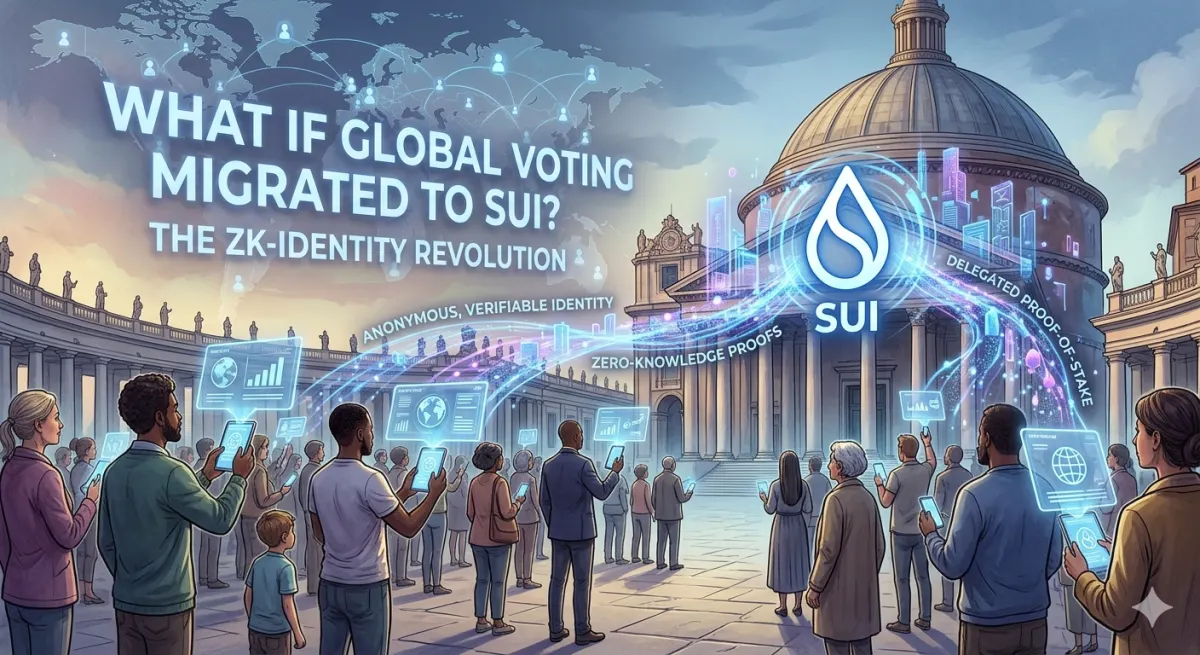
Sui's delegated proof-of-stake system already empowers token holders with weighted voting power through staking and delegation. Imagine scaling this to billions of global voters using zero-knowledge proofs for anonymous, verifiable identities-what if the world ditched paper ballots for Sui's blockchain?
This speculative shift could resolve the ZK-identity crisis, where privacy clashes with proof in digital voting. High-speed consensus and on-chain governance make Sui a prime candidate, but seismic changes loom across tech, markets, and society.
What Could Happen: Technical Foundations
Sui's architecture, built for speed and scalability, positions it uniquely for global voting. Its delegated proof-of-stake (DPoS) lets SUI holders delegate tokens to validators, determining voting power by stake weight each epoch-roughly 24 hours. Transactions finalize in under a second thanks to Mysticeti consensus, slashing latency by 80% from prior protocols.
ZK-Identity Integration
Zero-knowledge proofs (ZK) could enable voters to prove eligibility without revealing identities, tying into Sui's object-centric model. Owned objects skip consensus for fast personal votes, while shared objects ensure tamper-proof tallies.
- Delegators stake SUI to validators, mirroring voter credential delegation.
- ZK circuits verify age, citizenship via encrypted proofs on-chain.
- Epoch-based validator selection rotates trust, preventing central capture.
- Narwhal mempool and Bullshark BFT secure vote ordering for shared tallies.
- Governance proposals vote via token-weighted power, scalable to mass participation.
- Locking tokens boosts voting power-e.g., 12 months yields 3.1x multiplier.
- Rewards from gas fees incentivize honest validation and delegation.
This setup sidesteps traditional blockchain voting pitfalls like double-spending or coercion, as votes become NFTs or immutable objects post-confirmation.
Key Tech Edge: Sui distinguishes owned (fast, private) from shared objects, ideal for ZK-votes where individuals prove without consensus, but aggregates demand BFT security.
Market Impact: Tokenomics and Adoption Surge
A global vote migration would rocket SUI demand. With a 10 billion token cap and ~3.68 billion circulating, sudden utility as voting collateral could spike prices. Staking secures the network while funding development-50% of supply reserved for community incentives.
Economic Ripple Effects
Governments and NGOs buying SUI for voter subsidies would flood liquidity pools. Validators earn from gas and storage funds, distributing rewards proportionally minus commissions.
- Mass delegation inflates validator committees, pressuring stake concentration.
- ZK-identity dApps boom, drawing developers via grants.
- Circulating supply unlocks accelerate, hitting 50%+ by 2028 under demand.
- Gas fees from billions of votes create self-sustaining revenue.
- Interoperability with Ethereum ZK-rollups via bridges amplifies liquidity.
- Treasury (10% allocation) funds global rollout pilots.
- Venture unlocks (14%) fuel institutional validator networks.
Speculatively, SUI could mirror Solana's 2021 surge but with governance utility, pushing market cap past $100 billion amid regulatory nods.
$0.9886 Current SUI Price (as of March 14, 2026)
10B Total Token Supply Cap
75% Projected Staking Ratio Post-Adoption
3.68B Circulating Supply
Possible Outcomes: Scenarios and Risks
Outcomes hinge on adoption pace and hurdles. Optimistic paths yield decentralized democracy; pessimistic ones expose fractures.
Optimistic Scenario
Sui becomes the ZK-voting standard, with UN-backed pilots in 50 nations by 2030. On-chain proposals evolve protocols democratically.
- Voter turnout hits 90% via mobile ZK-wallets.
- Nation-state DAOs form for policy voting.
- SUI as global reserve asset for civic tech.
- Privacy wins: Coercion-proof via ZK and time-locks.
- Ecosystem grants spawn voting analytics dApps.
- Validator diversity grows via community reserves (50% allocation).
- Cross-chain bridges enable hybrid elections.
Pessimistic Scenario
Regulatory backlash or 51% attacks via stake whales derail trust.
Adoption Tip: Start small-delegate SUI today to test governance. Lock for 1-12 months to amplify voice, earning rewards while learning ZK-voting mechanics. Learn more about staking.
- Stake centralization empowers whales over masses.
- ZK implementation flaws leak data.
- Governments ban, fragmenting into regional chains.
- Scalability caps at 1B voters without sharding.
- Gas wars during elections spike costs.
- Oracle failures dispute real-world eligibility.
- Quantum threats obsolete early ZK schemes.
Bull Case: SUI hits $50, powering 2B voters.
Global elections seamless, fraud ends-democracy 2.0.
Bear Case: Price crashes to $1 on hacks.
Voter apathy persists; back to ballots amid scandals.
Broader Implications: Society and Beyond
Beyond markets, Sui-voting redefines power. Token holders gain protocol sway, akin to NS governance where votes cast NS-weighted ballots with rewards. Quorum thresholds ensure validity, locking boosts power exponentially.
Civic engagement surges as staking yields 5-10% APY from fees, subsidizing participation. Yet equity gaps widen-non-stakers sidelined unless airdrops bridge divides.
Sui's DPoS and ZK potential could heal identity crises in voting, but success demands inclusive delegation and robust audits. The real crisis? Not tech, but political will.
Early movers-developers, stakers-shape this future. As epochs tick, the question lingers: Will Sui vote the world into a new era, or remain a blockchain bystander?